
 |
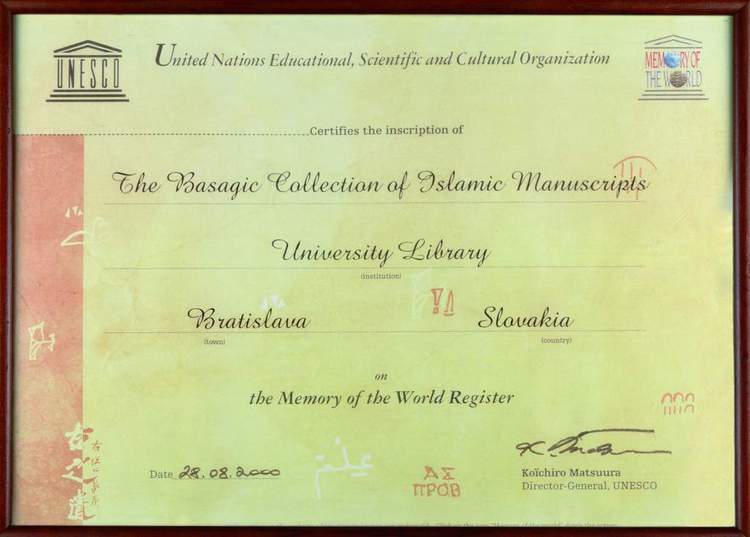
The Bašagic collection of Islamic manuscripts from the holdings of the University Library in Bratislava contains unique sources of world Islamic culture and through its significance as an outstanding and comprehensive documentation of Bosnia's written literature in 16th-19th centuries and a unique evidence of literary (prose, poetry) and scientific (Islamic theology, law, history, philosophy, Korans sciences, traditions, Islamic mysticism) activities of Bosnian Muslim scholars writing in Arabic, Turkish and Persian languages reaches world-wide importance. The University Library bought the Bašagić collection - this exceptional set of Islamic monuments of book culture - for its funds in 1924, following an offer from the famous Bosnian writer, scholar and collector Dr. Safvet beg Bašagić, after whom the collection was named. |
The Basagić collection has a multidimensional character and significantly documents not only the collector's broad interests, but above all the literary culture of Bosnia, its history, Turkish state administration and religious situation in the 16th - 19th centuries. However, the entire collection, in its significance and uniqueness, far exceeds the scope of Bosnia, as it contains the basic works of medieval Islamic scientific and beautiful literature. For example, there is a unique manuscript of Logic by the Islamic Aristotelian al-Farabi (950 AD), which is the most compact copy of the works of this renowned Muslim philosopher in the world, or the most widely known collection of quatrains by the famous Persian poet Omar Khayyam.
The collection today forms a separate fund in the University Library, which contains 598 manuscript works in 284 volumes. Of these, 393 are Arabic, 117 Turkish and 88 Persian works. There are 365 volumes of printed books, and they contain 496 works: 145 Arabic, 338 Turkish and 8 Persian. The whole is professionally processed and restored. The majority of the manuscripts were processed by Bašagić himself. Later, his catalogue was examined and supplemented by other experts.
 |
 |
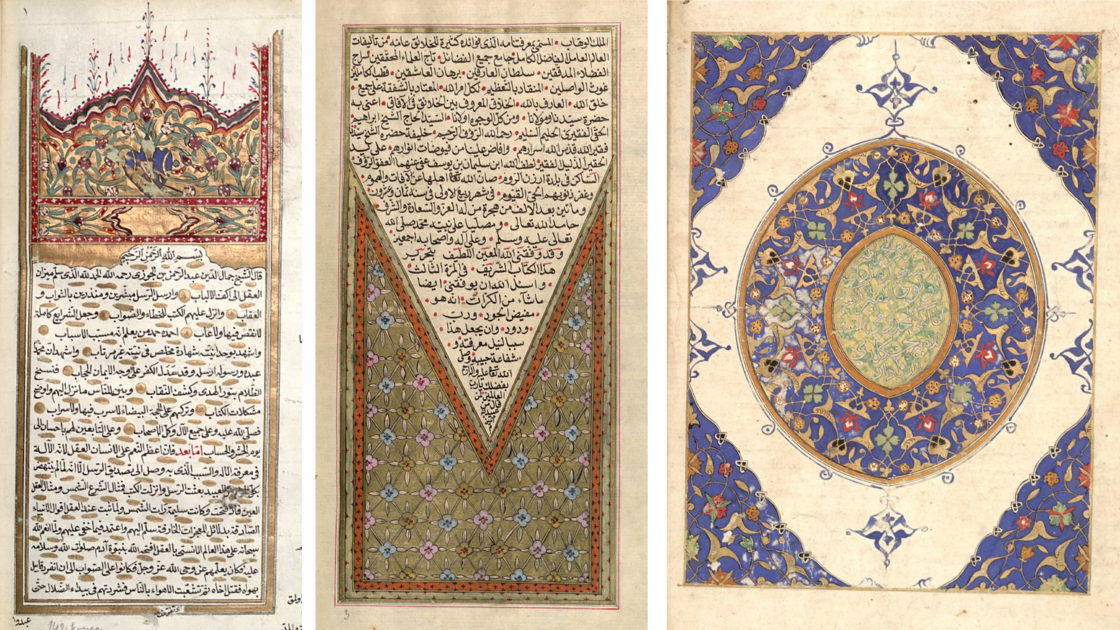
Fund thematically contains mainly works on religious sciences: the Quran, traditions, religious law, dogmatics, prayers, mysticism. In addition to philosophy, it also contains works on metaphysics, logic and psychology. Other scientific disciplines include astronomy, mathematics, politics, administration, laws, history, lexicography, grammar, metrics, rhetoric and poetics. Fine literature is represented by artistic poetry and prose, but also works of folk creativity. Among the manuscripts are also various lists, notes, commentaries and glosses. The manuscripts contain original, handwritten works of authors - autographs, but also copies made by professional scribes. In addition to common works, the collection also contains many unique items. Some of the most important are a copy of a codex from the beginning of the 12th century, written in 1194, an ethical work by Rághib al-Isbaháni, which is the oldest completely preserved book in the University Library's collections, and the rare poems of Ahmedi (1334-1413), the Book of Alexander, written in 1390. The unique manuscript of the encyclopedic work Marifetnáme - The Book of Science by Ibrahim Hakki is an artistic masterpiece. The oldest works among the manuscripts include a prayer book, a collection of celebratory poems in praise of the Prophet Muhammad, which is decorated with gold leaf. In religious literature, the autograph work by Ibrahim el-Bosnavi on the liturgies of the pilgrimage to Mecca is unique.
The books are bound in leather, mostly decorated with decorative blind-printed motifs, and are often gilded. The bindings are typically covered with a leaf protector - miqlab or mikleb.
This collection, whose manuscripts document the development of Islamic civilization over a long period of 1,300 years, from its origins in ancient Arabia to the end of the 19th century, is of immense importance to many nations of the world, and especially after the fire of the National Library in Sarajevo during the war in the former Yugoslavia, it is one of the rare and extremely rare documents of Islamic culture.
|